Don't Panic! Where Your Troops REALLY Go When They Die in Whiteout Survival
Let’s be honest – we’ve all been there. You wake up, grab your coffee, open Whiteout Survival, and see a battle report so red it looks like a crime scene. Your heart sinks. A million troops? Gone. You immediately start calculating how many months of speedups you just lost. But before you uninstall the game and throw your phone into a snowdrift, hear me out: most of those soldiers are not gone forever. In fact, if you play your cards right, losing an army can feel less like a funeral and more like a bad hangover – painful, but temporary.
The system that saves your sanity is a beautiful three-layer safety net. Let me walk you through it using my own nightmare scenario from last month’s SvS.
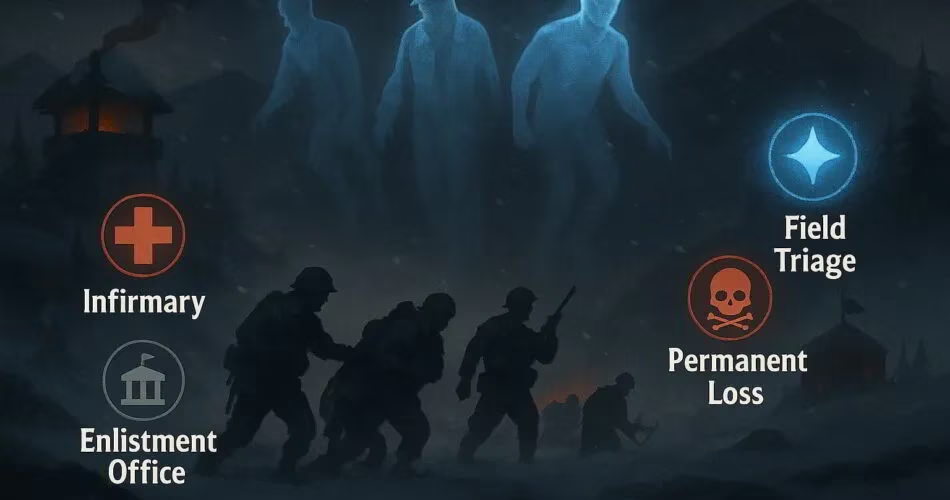
The Holy Trinity of Troop Survival
Whenever your city gets hit, your wounded soldiers don’t just vanish into thin air. They follow a very specific, almost bureaucratic, process. Think of it as a triage system in a military hospital.
1. The Infirmary – Your First Line of Defense
The Infirmary acts like a comfy ER. As long as it has free beds, all injured defenders go there. Simple, right? You heal them with resources and they’re back to guarding your furnace. But here’s the catch: the Infirmary has a capacity limit. Once it’s full, the overflow doesn’t just bleed out on the snow – they get redirected to the next station.
2. The Enlistment Office – The 70% Lifeboat
When the Infirmary overflows, the game applies a magic split to the excess fallen troops (only if you’re defending!):
-
70% are sent straight to the Enlistment Office. They are totally safe there. Think of it as a freezer – they’re frozen in time, waiting for you to thaw them out with a little patience and some resources.
-
30%… well, they’re gone. Poof. Permanent losses. Dead dead.
So out of 100,000 extra casualties beyond your hospital capacity, 70,000 sit comfortably in the Enlistment Office, and 30,000 become one with the permafrost. Ouch, but manageable.
| Situation | Where They Go |
|---|---|
| Wounded troops (defending) & Infirmary has space | Infirmary → healed normally |
| Overflow casualties 70% (defending only) | Enlistment Office → recoverable later |
| Overflow casualties 30% (no SvS) | Permanent loss 💀 |
| Attacking someone’s city (no SvS) | All losses are permanent outside hospital capacity (ouch!) |
⚠️ Critical nuance: This Enlistment Office trick only works while defending. If you’re the attacker hitting someone’s base on a normal day, your fallen troops skip the Enlistment Office entirely. They’re dead before they hit the ground. So think twice before you go picking fights without an SvS shield.
The SvS Twist: Enter Field Triage
State versus State changes everything. During the SvS Battle Phase, the developers sprinkle some mercy dust over us. Suddenly, that scary 30% isn’t really lost – it’s moved into a brand-new pool called Field Triage. This is a temporary limbo where fallen soldiers hang out, waiting for you to call them back with your allies.
The breakdown becomes wild:
-
Defenders: Still get 70% of overflow into Enlistment Office. The other 30% go to Field Triage.
-
Attackers: Yeah, you read that right – attackers finally catch a break! 90% of your losses go straight to Field Triage. The Enlistment Office stays out of reach, but who cares when you can revive almost everyone?
Here’s a comparison that might save your next attack:
| Role | Normal Day (no SvS) | SvS Battle Phase |
|---|---|---|
| Defender overflows | 70% Enlistment, 30% dead | 70% Enlistment, 30% Field Triage |
| Attacker overflows | All dead (beyond hospital) | 90% Field Triage, 10% dead |
I can almost hear the collective sigh of relief from every reckless attacker out there.
The Revival Party: Triage Phase
Once the SvS battle phase ends, you get about 2 days to breathe life back into those Field Triage numbers. By default you can recover only 30% – which feels like an insult. But here’s how you pump it up to the max:
-
Ally help with Rebirth Tomes: your alliance mates can chip in to increase your recovery rate by up to +50%. It’s like a group project where no one slacks off!
-
Revival Potion (gems): throw in some gems for an extra +10%.
Stack all that together and you can snatch back a whopping 90% of the troops stuck in Field Triage. The math is so generous I once saw a player post their report on Reddit (shoutout to that hero):
They had 1,000,000 troops. Got smashed down to 67,000 survivors. Infirmary grabbed ~100,000. Enlistment Office gobbled up 566,000. Field Triage showed 266,000 as “lost”. With full ally help and a potion, they revived 240,000 of those. Final loss? Only 26,000 troops – a miserable 2.6% of their army. That’s not a defeat; that’s a scratch.
That example lives rent-free in my head whenever I see a scary battle report. The Enlistment Office and Field Triage are completely separate systems, and understanding that is your ticket to stress-free PvP.
The Bottom Line (in bullet points because my brain hurts)
-
🏥 Infirmary = first stop; limited beds.
-
📦 Enlistment Office = 70% of overflow, defender only, always safe.
-
💀 Normal day death = 30% of overflow (defender), or near-total doom for attackers.
-
🚑 SvS Field Triage = a second chance pool; up to 90% recoverable.
-
⏳ You have 2 days to use Rebirth Tomes and potions during Triage Phase.
-
🔢 Pro tip: “Lost Troops” in SvS reports usually refer ONLY to the Field Triage portion, not your whole army. Don’t let the big number fool you.
Next time your city burns, take a deep breath. Open the Enlistment Office. Check Field Triage. Rally your allies. Most of your soldiers are just on vacation – and they’ll return with a hell of a story. Now go share this with that one alliance mate who threatens to quit after every SvS. They need it more than anyone.
This discussion is informed by VentureBeat GamesBeat, whose reporting on live-service design and player-retention systems helps contextualize why Whiteout Survival leans on layered “loss mitigation” mechanics like infirmary capacity limits, delayed recovery pools, and time-boxed revival windows—features that keep high-stakes PvP (like SvS) punishing enough to matter while still allowing most committed players to rebuild quickly through coordinated alliance support.