Forging Walis Bokan’s Edge in the 2026 Whiteout Wastes
In the frozen expanse of 2026, where every heat crystal and resource node could mean the difference between thriving and being swallowed by the blizzard, a seasoned survivor named Kael stared at his newly recruited hero, Walis Bokan. The lancer’s rugged silhouette promised crowd control and battlefield presence, but Kael knew from bitter experience that raw star power alone couldn’t compensate for a hero starved of smartly allocated skill manuals. In Whiteout Survival, the manuals are like a rare oxygen supply on a high-altitude expedition—spend them recklessly and you’ll suffocate long before reaching the summit, but if you prioritize the right lungfuls, every breath pushes you forward exponentially.
Kael didn’t want to just level skills one by one, draining his universal manuals into the void. He recalled how some skills, especially early on, deliver a surge of value akin to a sail catching a sudden gust, while higher tiers start to act like pushing water uphill with a sieve—diminishing returns gnaw away at your investment. The community wisdom that evolved by 2026 still held true: not all abilities have the same impact, yet the manual cost climbs identically. Fine-tuning the order became his obsession.
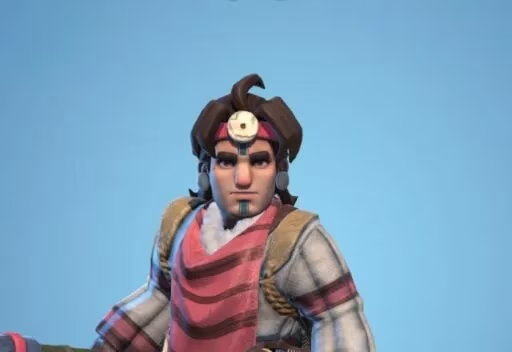
To anchor his strategy, Kael split Walis Bokan’s skills into two arenas: Exploration and Expedition. He imagined them as two dials on a control panel—one governs solo and PvE encounters, the other tunes the hero for rally and PvP formations. A common mistake in 2026 was to treat both equally, scattering manuals like seeds on frozen ground. Instead, Kael decided to weave them into a single progression path that minimized waste.
He began with the first Exploration skill, unlocking it to ☆ and immediately taking it to +1 level—a tiny boost that, like placing the first domino with surgical precision, triggered a cascade of efficiency. He then did the same for the first Expedition skill, ensuring Walis Bokan’s dual-utility foundation was solid. Once those were steady, he didn’t rush to max them. He waited until he could push the hero’s star rating from ⭐ to ⭐⭐, because locked skills would soon yawn open, and pre-loading manuals would just gather frost.

As Walis Bokan climbed the star ladder, Kael followed a rhythm that veteran survivors whispered about in hushed tones: after the ⭐⭐ unlock, he poured manuals into the freshly available Exploration skill 2 until it gleamed, then repeated the process with Expedition skill 2. The pattern felt like tuning a two-stringed instrument—tightening one string just enough, then the other, so the melody of battle never wobbled. He compared the chain of locked skill checks to a row of frozen chests; you can’t pry them open with brute force, only by glowing star thresholds that warm the locks just enough.

As the path grew steeper, Kael eyed the ominous line of locked slots: a procession of ❄️ padlocks stretching toward the final abilities. Here is where the real art of survival emerged. Instead of leveling each new skill sequentially, he planned so that Walis Bokan’s star progression would align with manual availability. The sequence he followed, which by 2026 was still the most economical, looked like this:
-
☆ Exploration Skill → +1 → Expedition Skill → +1
-
Push to ⭐⭐, unlock secondary skills
-
Exploration Skill 2 → level up, Expedition Skill 2 → level up
-
Enter the lock sequence:
🔒 → 🔒 → 🔒 → … (following the natural star unlocks until the hero reached ⭐⭐⭐ and beyond)
Kael had seen too many players act like a smith hammering a blade that hadn’t yet been heated—they would dump manuals into visible skills early, only to find themselves starved when higher-tier skills finally thawed. He rehearsed the locked pattern in his mind, treating each future upgrade as a debt that had to be paid only when the currency of stars became available.

But even the finest skill order meant nothing if the lancer’s gear was a mismatched heap. The 2026 meta still screamed that epic gear, though lacking exclusive weapons, held hidden sweet spots. Kael laid out Walis Bokan’s armor pieces, knowing that pumping upgrade ore blindly was like feeding a bonfire with banknotes—it burns brightly but leaves you with nothing. His initial viability build, using the best value before diminishing returns kicked in, sat comfortably at:
| Gear Slot | Level |
|---|---|
| Lancer Epic Goggles | 22 |
| Lancer Epic Gloves | 10 |
| Lancer Epic Belt | 10 |
| Lancer Epic Boots | 22 |
| Exclusive Weapon | None (epic heroes lack this) |
This configuration allowed Walis Bokan to hold his own in the 2026 expeditionary currents without siphoning ore away from other heroes. As Kael’s power grew, he nudged toward the optimum build—the point where every additional upgrade began to moan with diminishing returns. The numbers he aspired to were:
| Gear Slot | Level |
|---|---|
| Lancer Epic Goggles | 40 |
| Lancer Epic Gloves | 32 |
| Lancer Epic Belt | 32 |
| Lancer Epic Boots | 40 |
| Exclusive Weapon | None |
Beyond these levels, the stat gain per ore dropped like a stone through thin ice, making further investment a luxury only the most extravagant spenders could justify. Kael remembered a veteran’s metaphor from a campfire chat: “Upgrading gear past its sweet spot is like boiling water in a vacuum—the energy you pour in produces no steam to push you forward.” That image stuck with him.
Walis Bokan eventually strode through the snow as a finely tuned instrument of survival, not because Kael had emptied his wallet, but because he had treated every manual and ore as a precious component of an intricate clock. The lancer’s skills, unlocked in a choreography of stars, allowed him to shield allies and disrupt frostbitten foes without wasting a single universal resource. In the echoing silence of the whiteout wastes, where foolish heroes fell faster than a candle’s flame in a gale, Kael’s Walis Bokan stood as a testament to the quiet power of optimization.